
PSHB Research Apple and Pear trees wanted!
Removing a block of Apple or Pear trees this year?
Your unwanted trees could contribute to important PHSB research before they are removed.
Duccio Migliorini from the Harry Butler Institute at Murdoch University is currently looking for healthy plant material for a laboratory experiment aimed at assessing the susceptibility of WA plants to Polyphagous Shot Hole Borer (PSHB) and its fungal partner Fusarium euwallaceae.
He is interested in collecting healthy stems or branches with stem diameters ranging from 3–4 cm up to 8–10 cm from apple and pear trees. The maximum amount required per species/cultivar would be approximately 5 metres of stems.
Please contact Susie for more information and find out how you could assist.
Testing the Impact of PSHB associate Fusarium on Western Australian Plants
The Polyphagous Shot Hole Borer (PSHB) and its fungal partner Fusarium euwallaceae pose a serious emerging threat to Western Australia’s agriculture, urban trees, and natural ecosystems.
These organisms work together: the beetle introduces the fungus, its food source, into plant tissue, where the pathogen spreads and can cause branch dieback, structural weakness, and tree death. Many plant species worldwide have been reported as hosts, including ornamental and crop plants that are widely present in Western Australia.
If susceptible plant species are identified early, surveillance and management strategies can be directed where they are most needed. This reduces the risk of large-scale damage.
By testing a wide range of plant species, including crop species, native trees and shrubs, and ornamental plants used in urban landscape, I aim to assess how susceptible Western Australian plants are to the PSHB-associated fungus.
This investigation will provide:
• Early identification of plant species and cultivars at greatest risk
• Information on plant susceptibility and disease development
• Guidance for current management
To carry out this research, I am seeking healthy stem material from apple and pear cultivars. If you have plants available, or would like to discuss potential collections, please get in touch.
I require healthy branches or stems from field-grown plants:
• Diameter: 3–8 cm (up to 10 cm maximum)
• Length: ideally harvested in ~2 m sections (maximum 2.5 m), as long as possible for transport to prevent dehydration before processing
• Quantity: approximately 4–5 metres in total (smaller amounts are also acceptable)
• Rootstock material is also highly valuable where available
Collected stems will be transported to Duccio Migliorini
Harry Butler Institute - Murdoch University
Email: Duccio.Migliorini@murdoch.edu.au
Phone: 0426148394quarantine facilities at Murdoch University and cut into 20–40 cm sections for laboratory testing.
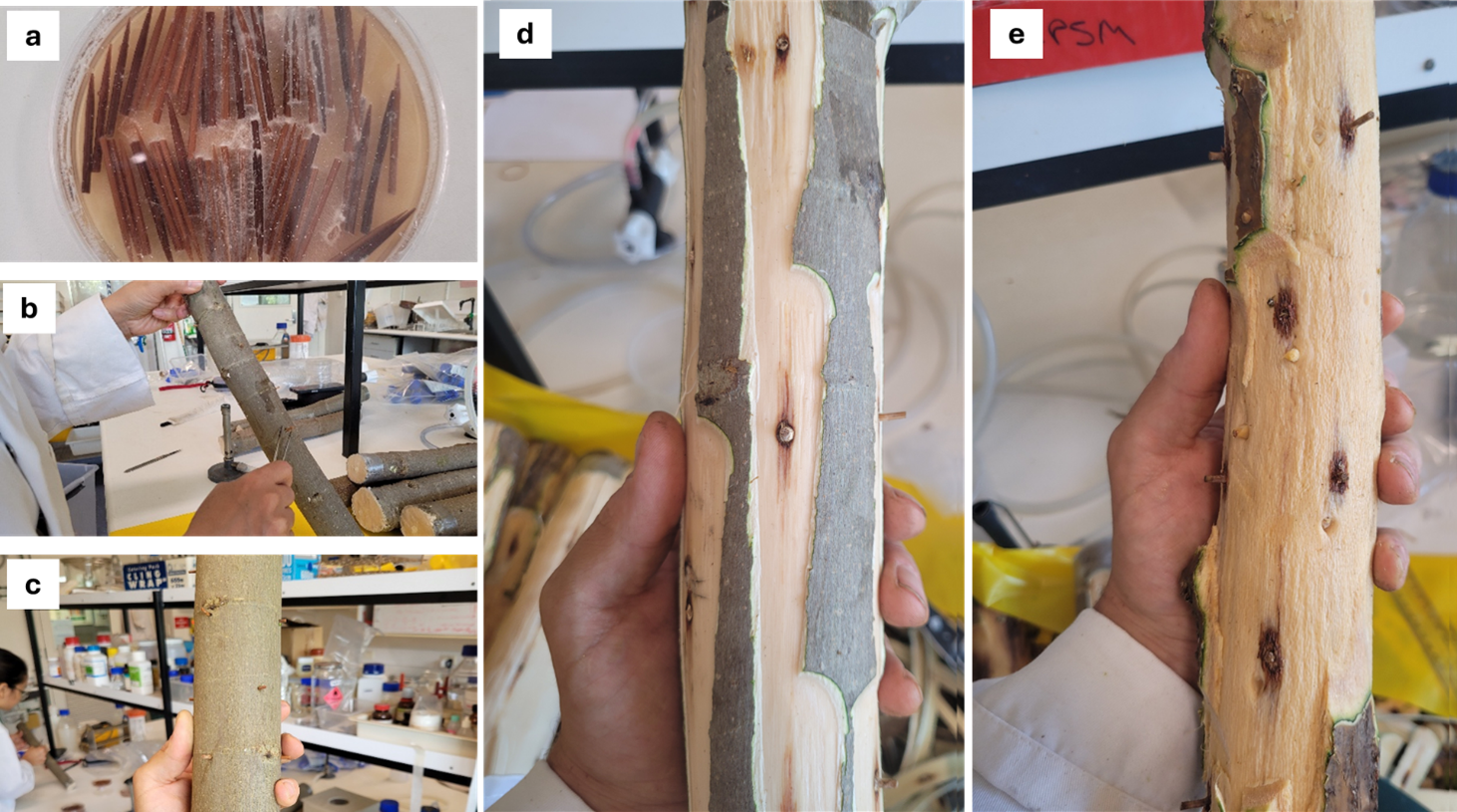
How the testing works
1. Fungal inoculation
Small holes are drilled into the stem and inoculated with the PSHB-associated fungus grown on sterile toothpicks.
2. Laboratory incubation
Stems are kept under controlled conditions for five weeks at different temperatures.
3. Disease assessment
The development of internal lesions in the wood is measured after five weeks to determine how susceptible the plant species is.
4. Pathogen confirmation
The fungus is re-isolated from infected tissue to confirm its role in the disease.
If you can help please contact researcher below…
Duccio Migliorini
Harry Butler Institute - Murdoch University
Email: Duccio.Migliorini@murdoch.edu.au
Phone: 0426148394