
Biosecurity bites: Mediterranean fruit fly (Medfly) Ceratitis capitata
Medfly is a serious pest of fruit crops, now endemic to parts of WA after first being discovered in 1895. Medfly is found from Carnarvon to Bunbury, with activity highest around townsites, rubbish tips and backyard fruit trees that provide year round habitat. It attacks up to 200 plant species and is considered a pest of trade concern for WA.
Factors in pest pressure
Proximity to townsites, unmanaged orchard or feral fruit trees in river systems can increase pest pressure on individual orchards. During times of high pressure or in a warm year, coordinating control measures with neighbouring properties can increase successful management. DeLima, 2025 found coordinated baiting to be more effective than cover sprays across an area.
Adult Medfly increase in number as soft skinned fruit becomes ripe, allowing more opportunities for eggs to be laid inside fruit. If stonefruit are grown near your orchard, populations would likely increase from January onwards. If you are close to a townsite, the adult flies emerge in spring as the temperature increases after sheltering in compost heaps or citrus fruit over winter.
Preferred hosts:
· Apricot
· Peach
· Lemon
· Apple
· Pear
· Orange
· Persimmon
· Mango
· Loquat
· Fig
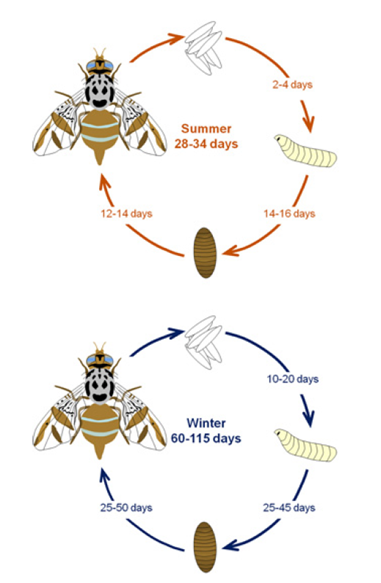
Life cycle
The Medfly life cycle varies with temperature, taking up to 115 days in winter and 30 days in summer to complete a life cycle. This is how the species survives in temperate climates through cooler winters when food may be scarce. In warm areas (minimums above 12⁰C) Medfly can also survive winter as an adult.
In temperate areas Medfly tends to emerge from the ground in mid-spring and remain active until May. Trapping from the PIPS 4 Profit IPDM project saw adult Medfly caught in residential areas from November while orchards did not see activity until December/January.
Identification
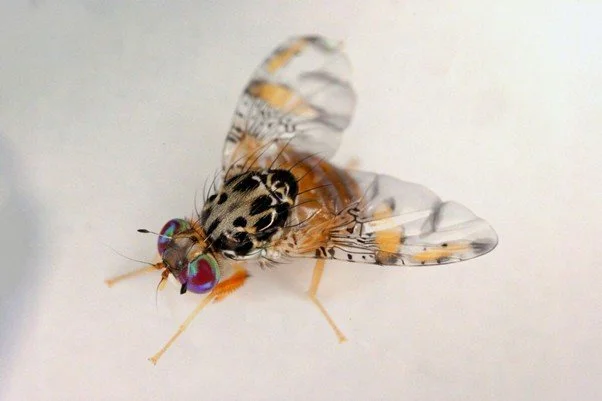
Medfly are 3-5mm long with a brown banded body and have yellow spots on the wings. Don’t confuse for Qfly which are larger and have clear wings.
If you can get a good quality photo, send to MyPestGuide for identification.
Control Priorities for Growers
There are several options for surveillance and control.
Trapping
If using traps, begin trapping when fruit is at half size. Check traps weekly to fortnightly, be sure to change pheromones and bait according to manufacturer recommendation. If you are concerned that traps bring pests into the orchard, mass trapping along boundaries where you expect pressure can serve as an early warning sign. If using a wet bait trap such as CeraTrap ensure the lure does not dry out, as it will continue to attract flies without killing them. Mass trapping with intention to control populations requires at least 25 traps per hectare.
Baiting
Commence baiting when fruit is half size or once the first fly is caught in traps. Apply bait at least once a week, bait twice weekly if traps are finding more than three flies per trap per week. Don’t apply bait to the same tree more than once a week, alternate rows if frequent baiting is required. Reapply bait if it rains. Remember to bait windbreaks and non-fruiting evergreens in the orchard.
Orchard Hygiene
Post-harvest orchard sanitation is crucial to managing Medfly.
· Remove or control non-commercial hosts near the orchard
· Remove fallen fruit from the orchard, regularly mulch fallen fruit to destroy larvae before they move into the soil
· Do not leave fruit on trees after harvest or over winter
· Correctly dispose of reject fruit from grading and packing, daily
More information on treatments and disposal can be found on the DPIRD website: Mediterranean fruit fly | Department of Primary Industries and Regional Development
Source: De Lima, C. P. F., Poogoda, S. R., Mansfield, E. R., & Collie, H. M. (2025). Suppression of the Mediterranean Fruit Fly in Semi‐Temperate Areas of Western Australia: A Review of Over 30 Years of Area Wide Management Practice. Journal of Applied Entomology, 149(7), 1129-1145.